

New national report calls for coordinated education and communication strategy to strengthen agricultural risk management
An essential step to building more resilient, competitive and successful farm businesses
OTTAWA, Ontario, July 30, 2026 (GLOBE NEWSWIRE) -- Farm Management Canada has released a new report promoting a National Strategy for Education and Communication on Agricultural Risk Management, calling for a coordinated, pan-Canadian approach to help producers and service providers better understand, navigate and apply the full range of programs, practices and tools to manage agricultural risk.
While Canada has developed an extensive suite of BRM programs and related support mechanisms, the evidence presented in this report demonstrates that the effectiveness of these tools is increasingly constrained by persistent gaps in education, communication, and coordination of these efforts. These gaps extend beyond reactive programs to include limited understanding and uptake of proactive risk management practices that support preparedness, prevention, and long-term resilience. As a result, producers and service providers do not consistently have the clarity, confidence, or support required to integrate comprehensive risk management into day-to-day business decision-making. The central challenge is the absence of a coherent and accessible knowledge infrastructure that connects available tools to farm-level action.
“Education and communication are not add-ons to agricultural risk management; they are part of the infrastructure that makes the entire system work,” said Heather Watson, Executive Director, Farm Management Canada. “Canada has invested significantly in programs and tools, but those investments cannot deliver their full value unless we can understand them, assess their relevance and confidently put them into practice. This strategy offers a practical path to close that gap.”
The National Strategy builds directly on the 2025 CAPI report Striking the Balance: Proactive Strategy versus Reactive Response, authored by Farm Management Canada, which called for a modernized approach that recognizes Business Risk Management (BRM) programs as essential, while placing greater emphasis on comprehensive, proactive risk management including planning, prevention, preparedness and adaptation. The new report carries that work forward by identifying the education, communication, coordination and advisory capacity needed to turn proactive risk management from a policy objective into consistent on-farm action.
The strategy closely aligns with the recent Halifax Statement issued by Canada’s federal, provincial and territorial ministers of agriculture. The Statement identifies sector resilience as a central priority for the Next Policy Framework and specifically calls for advancing proactive risk management and climate adaptation, recognizing diverse risk management approaches, strengthening emergency planning, improving BRM programs and enabling data-informed decision-making. Its emphasis on collaboration, coordination, knowledge transfer, accessibility and long-term planning reflects the same conditions the National Strategy identifies as necessary for success.
“The Halifax Statement sets a clear direction: Canada wants an agricultural sector that can anticipate, withstand and adapt to disruption,” said Mathieu Lipari, National Risk Management Lead, Farm Management Canada. “This strategy shows how we can support that ambition. Farmers need more than isolated program descriptions; they need trusted, practical and sector-relevant guidance that connects risk awareness to proactive planning, informed decisions and action.”
The report recommends four mutually reinforcing actions:
- Establish a permanent, multi-stakeholder National Agricultural Risk Management Task Force or Roundtable to sustain coordination, shared ownership and continuous improvement.
- Develop and promote a shared National Risk Management Framework that presents risk management as a continuum spanning preparedness, prevention, mitigation, response and recovery.
- Structure clear pathways from risk management information to application, closing the gap between risk awareness and on-farm risk management implementation across production sectors and regions.
- Embed systematic feedback and learning mechanisms to track how risk management programs and tools are used so that education and communication efforts can evolve with producer needs, emerging risks and changing sector priorities.
The proposed strategy would not replace existing programs, centralize delivery or prescribe farm-level decisions. Instead, it would provide a common foundation while allowing education and communication to be adapted to regional realities, production sectors, farm size, business stage and access to advisory support. It would also clarify complementary roles for governments, farm agricultural service organizations, financial institutions, academic institutions, advisors and producers.
By making risk management easier to understand and implement, the strategy aims to strengthen confidence, reduce uncertainty and help producers make timely, forward-looking decisions. Over time, better education and communication can improve the value of public and private investments, support better use of BRM programs and program improvements, encourage proactive planning, and create stronger conditions for innovation, adaptation and long-term competitiveness.
The full National Strategy for Education and Communication on Agricultural Risk Management, is available through Farm Management Canada. Striking the Balance: Proactive Strategy versus Reactive Response is available through the Canadian Agri-Food Policy Institute.
About Farm Management Canada
A national umbrella for Canadian farm business management activity, Farm Management Canada is the only organization devoted exclusively to the development and delivery of advanced business management information, tools and learning opportunities to position Canada’s farmers for success. Programs and activities are made possible through support from generous sponsors and supporters, including government, private industry, the non-profit sector and academia.
Media Contact
Mathieu Lipari
National Risk Management Lead
Farm Management Canada
Mathieu@fmc-gac.com
A photo accompanying this announcement is available at https://www.globenewswire.com/NewsRoom/AttachmentNg/1c69ddc9-5358-43b4-a180-adf9ae29b018

New national report calls for coordinated education and communication strategy to strengthen agricultural risk management
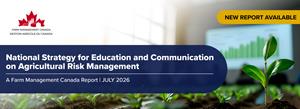
Farm Management Canada has released a new report promoting a National Strategy for Education and Communication on Agricultural Risk Management, calling for a coordinated, pan-Canadian approach to help producers and service providers better understand, navigate and apply the full range of programs, practices and tools to manage agricultural risk.
Legal Disclaimer:
EIN Presswire provides this news content "as is" without warranty of any kind. We do not accept any responsibility or liability for the accuracy, content, images, videos, licenses, completeness, legality, or reliability of the information contained in this article. If you have any complaints or copyright issues related to this article, kindly contact the author above.
