
Yemen Cannot Wait
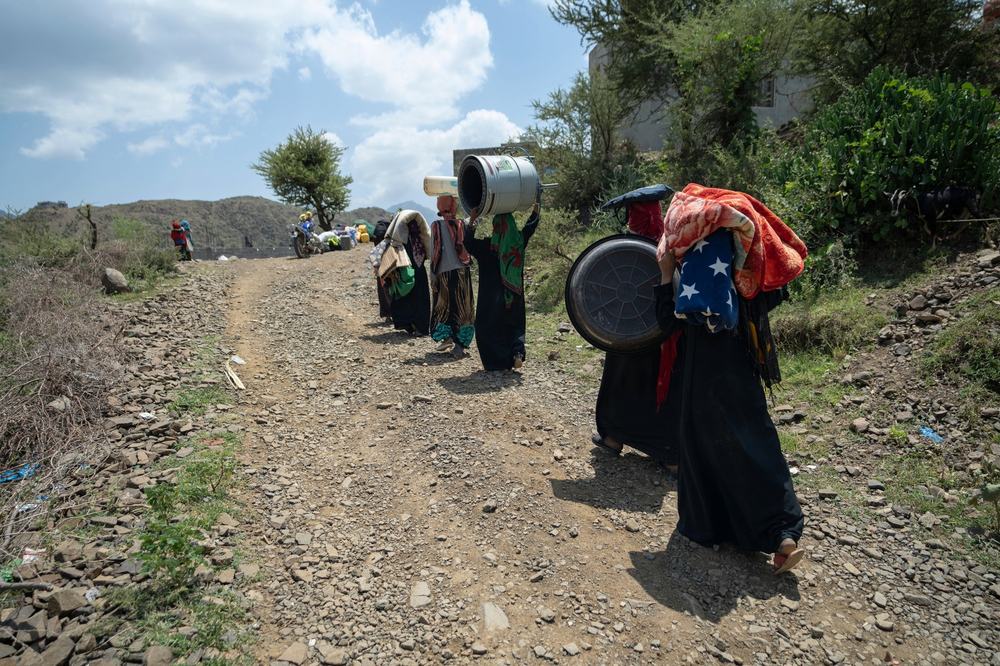
Displaced families head toward Al-Shaqadif Camp and its surrounding areas after leaving Al-Malika Camp, fleeing the escalation of shelling and military operations in the area. Almaafer/Taiz, September 2026. (Photo: Hussam Alshurmani/Oxfam)
A crisis intensifying, not contained
Across Yemen, 22.3 million people need humanitarian assistance and protection. At least 18.3 million people are acutely food insecure, while more than 2.2 million children under five and 1.3 million pregnant and breastfeeding women are acutely malnourished. Food security is therefore among the most urgent priorities. The impacts are not experienced equally: women and girls face heightened malnutrition and protection risks, and adolescent girls are especially vulnerable as household economic pressure intensifies.
The latest partial IPC analysis covers Government of Yemen-controlled areas only. It projects 5.4 million people in Crisis or worse (IPC Phase 3+) during June to September 2026, including 1.6 million in Emergency (IPC Phase 4). The absence of comparable current IPC analysis for northern Yemen must not be interpreted as evidence of lower need. The most recent IPC projection for areas under the Sana’a-based authorities covered September 2025 to February 2026 and projected 12.8 million people in IPC Phase 3 or above, including more than 41,000 in Catastrophe (IPC Phase 5). These periods are not directly comparable, but together they underline the scale of need and the importance of protecting independent needs assessment and data collection across all of Yemen.
Regional tensions and renewed fighting inside Yemen are sharply increasing risks to civilians and to the fragile gains of the 2022 truce. On 7 August, the UN Special Envoy warned that Yemen faced a greater risk of renewed large-scale conflict than at any point since the April 2022 truce, citing attacks in Ma’rib and Hadramawt that reportedly caused civilian casualties, renewed attacks on commercial shipping, and strikes on civilian infrastructure including airports. Military activity has since intensified across multiple front lines. Renewed fighting is also driving rapidly rising displacement. As of 18 September, IOM’s Displacement Tracking Matrix had recorded more than 120,000 people displaced since the current escalation began in June, particularly in Ta’iz and Lahj. This reflects only movements captured through IOM tracking, not a comprehensive national total, and recorded displacement continues to rise. All parties must de-escalate, protect civilians and civilian infrastructure, and avoid drawing Yemen deeper into the wider regional confrontation.
The 2026 Humanitarian Needs and Response Plan seeks US$2.16 billion to reach 12 million people, including 9.4 million prioritised for targeted life-saving assistance. As leaders gather for the UN General Assembly, the Yemen response remains severely underfunded relative to the scale of needs. Further contraction will mean fewer nutrition, health, water, sanitation, education, protection and cash services, while also reducing the staff, systems and local organisations needed to respond to new shocks.
The choice is not between humanitarian relief and recovery. Yemen needs both.
Keeping people alive while essential systems continue to fail only pushes humanitarian need forward. Financing essential services, livelihoods and local delivery capacity is part of preventing further deterioration and reducing future needs.
Economic decline and failing services are humanitarian needs drivers
Yemen’s humanitarian emergency cannot be separated from the economy. The World Bank estimates that national real GDP contracted by 1.5 per cent in 2025 and projects a further 0.5 per cent contraction in 2026; government revenue fell to 5.6 per cent of GDP. Weak revenues, disrupted salaries, limited access to finance and rising costs reduce household purchasing power, placing particular pressure on women who often absorb increased unpaid responsibilities, while also undermining the ability of public institutions to keep health, water and education services functioning.
Regional disruption adds to the pressure on a country that depends heavily on imported essentials. Yemen is highly exposed to rising global prices, supply disruptions and increased shipping costs. Disruptions linked to the wider Middle East conflict and regional shipping routes are increasing transport and input costs, threatening food affordability and further eroding household purchasing power. Climate shocks, particularly water scarcity, drought and flooding, compound the same vulnerabilities. International support should therefore protect basic services and household incomes while expanding climate-adapted water systems, renewable energy for essential services, agriculture, fisheries and livelihoods. These investments should not be postponed until after a comprehensive political settlement.
Hunger, nutrition, health and water needs will surge without support
Yemen is facing a dangerous deterioration in hunger just as funding cuts and operational constraints are scaling back critical life-saving services. In 2026, 14.4 million people require water, sanitation and hygiene assistance, while only 59.3 per cent of health facilities are fully functional. Reduced WASH capacity limits access to safe water and sanitation and increases public-health risks, while health facilities in parts of the country face shortages of medicines, nutrition supplies, staff and operating support as humanitarian programmes reduce or halt services. Humanitarian organisations working in northern governorates report massive unmet food security, malnutrition and health needs, while the lack of current comprehensive data limits visibility of the full scale of the crisis. Women, girls and children face particular risks when such services are disrupted, including barriers to maternal, sexual and reproductive health care, greater exposure to preventable disease, and protection risks. The response must prioritise safe water and sanitation, food, nutrition and essential health services, including mental health and psychosocial support, across all of Yemen and sustain support close to communities before conditions deteriorate further.
Humanitarian access and aid-worker safety must be protected
Humanitarian organisations cannot respond effectively when personnel face detention, threats or restrictions on safely reaching the communities they serve. Since June 2024, dozens of national staff from the United Nations, national and international NGOs, civil-society organisations and diplomatic missions have been arbitrarily detained by the de facto authorities (DFA) in Sana’a, alongside personnel detained in earlier and later waves. These detentions harm staff and their families and constrain humanitarian and development action.
All arbitrarily detained UN, NGO, civil-society and diplomatic personnel should be released immediately, safely and unconditionally.
All parties and authorities should ensure full, safe and sustained humanitarian access; protect national and international aid personnel and local organizations; remove unnecessary administrative impediments; and enable the safe movement of female humanitarian staff whose access is essential to reach women and girls in communities. Independent needs assessments must be possible wherever needs exist. Member States and regional actors should sustain diplomatic engagement to secure the release of arbitrarily detained personnel.
What leaders at UNGA 81 should deliver
During High-Level Week, Member States, donors, United Nations leaders and international financial institutions should turn these priorities into five practical outcomes:
- Fund the response before more capacity is lost.
Commit additional financing for the 2026 Yemen response and prioritise flexible, multi-year support for food, nutrition, health, mental health and psychosocial support, water and sanitation, education, protection and multipurpose cash, including for women, girls and other groups facing barriers to assistance. Protect the ability of organisations to retain staff, systems and readiness in underserved areas. Further cuts will not only reduce assistance today; they will erode the capacity to respond to the needs of millions of Yemenis tomorrow.
- Facilitate safe, unimpeded humanitarian and commercial access.
Press for the immediate release of arbitrarily detained personnel and for full, safe and sustained humanitarian access. Ensure sanctions and counter-terrorism safeguards are usable in practice and resolve legitimate payment barriers quickly so humanitarian and commercial actors can continue to operate. Safeguard humanitarian supply chains and commercial imports to support timely delivery of life-saving commodities and essential goods.
- De-escalate the conflict and protect civilians.
Use diplomatic engagement to press all parties to immediately de-escalate and comply with international humanitarian law, including the protection of civilians and civilian objects. This includes schools, hospitals, water systems, roads, ports and airports that provide vital lifelines for millions of people. All parties must renew meaningful efforts towards an inclusive Yemeni-led political process under United Nations auspices that can put the country on a path to sustainable peace.
- Keep essential systems functioning and reduce pressure on households.
Align humanitarian, development and economic support around health, water, education, social protection, livelihoods and purchasing power, while addressing the disproportionate burdens faced by women. Support practical, transparent and nationally inclusive arrangements for regular public-sector salary payments, protected from political interference and addressed within wider economic and peace negotiations. Protecting household purchasing power and the systems people depend on is essential to preventing further humanitarian deterioration.
- Finance recovery, climate adaptation and inclusive peace now.
Invest now in climate-adapted water infrastructure, renewable energy for essential services, livelihoods and local economic recovery. Ensure Yemeni civil society, particularly women’s organizations, women, young people, affected communities, local authorities, marginalized groups and persons with disabilities, have meaningful influence over humanitarian, recovery and peace priorities before decisions are made.
Yemen cannot wait for compounding shocks to make its crisis visible again.
Leaders meeting in New York should use national statements, bilateral meetings and financing decisions to prioritize Yemen, protect civilians and humanitarian access, keep commercial lifelines and essential services functioning, and invest in a Yemeni-led path out of crisis.
Legal Disclaimer:
EIN Presswire provides this news content "as is" without warranty of any kind. We do not accept any responsibility or liability for the accuracy, content, images, videos, licenses, completeness, legality, or reliability of the information contained in this article. If you have any complaints or copyright issues related to this article, kindly contact the author above.
